

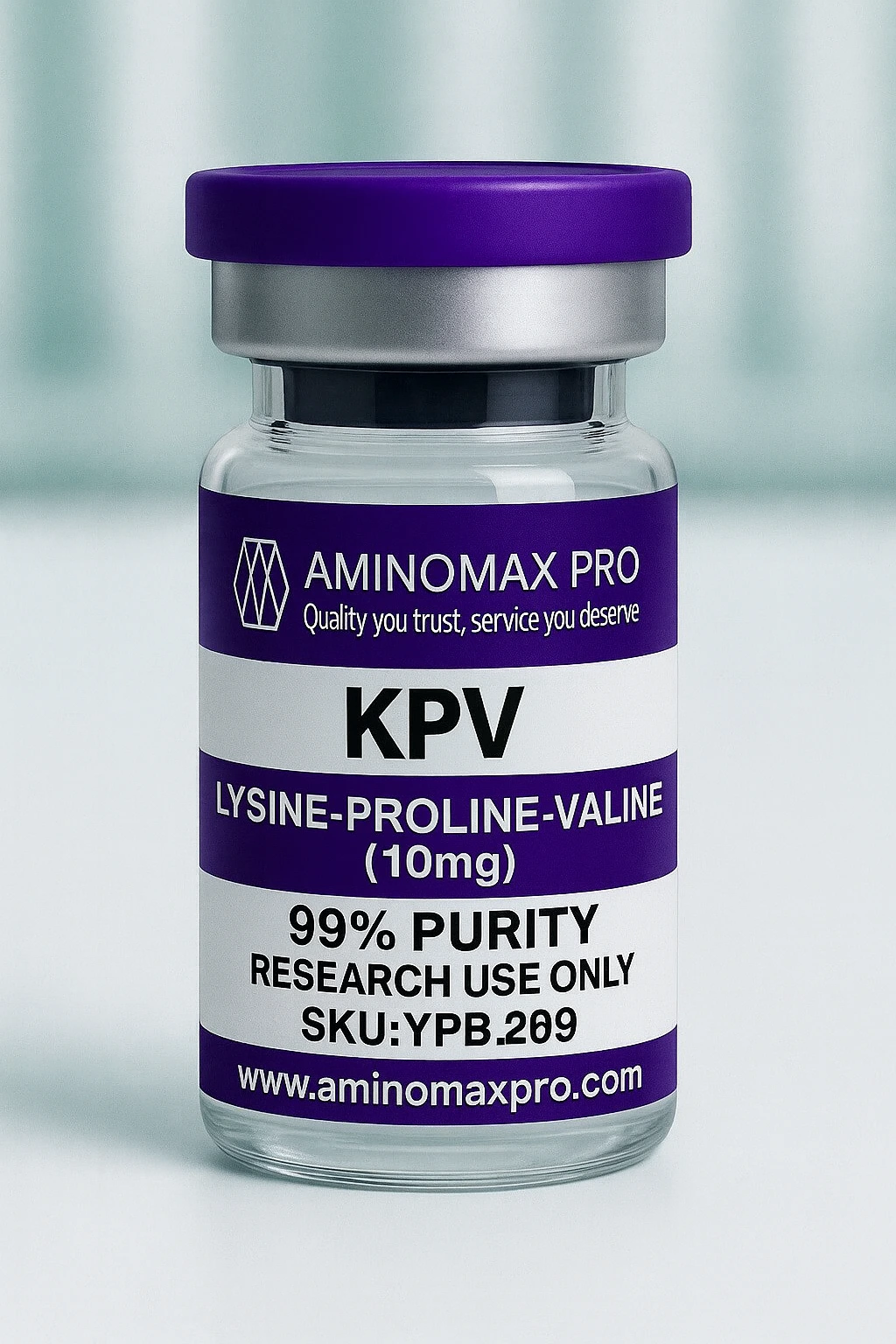
This material is supplied exclusively as a laboratory research chemical for in vitro scientific study. All descriptions and documentation are provided for informational and educational purposes only.
This compound is not approved for human or animal consumption, injection, ingestion, inhalation, topical use, or any other biological application. It must be handled only by qualified, trained personnel in a properly equipped laboratory.
This product is not a drug, supplement, food, cosmetic, or therapeutic agent, and it may not be rebranded, repackaged, or marketed as any such item. Misuse, mislabeling, or unauthorized application is strictly prohibited.
Nothing on this website constitutes medical advice, professional guidance, or a recommendation of use.
(α-MSH–Derived Tripeptide Fragment; NF-κB/Inflammasome Pathway Modulator – Research Use Only)
KPV (Lys-Pro-Val) is a naturally occurring C-terminal tripeptide fragment of α-melanocyte-stimulating hormone (α-MSH).
In in-vitro research systems, KPV has been observed to interact with melanocortin receptors (primarily MC1R) and suppress pro-inflammatory transcription factors such as NF-κB, while modulating cytokine gene programs associated with epithelial and immunologic signaling.
| Target | Mechanistic Role |
|---|---|
| MC1R (melanocortin-1 receptor) | GPCR; cAMP/PKA signaling; anti-inflammatory transcription |
| NF-κB complex (p65/p50) | Major pro-inflammatory transcription factor |
| NLRP3 inflammasome | IL-1β maturation/caspase-1 signaling |
| TLR (LPS-responsive pathways) | Pattern-recognition transcription activation |
KPV does not mimic full α-MSH hormonal activity; effects are mediated through selective receptor-linked and intracellular signaling interference.
Ligand binding at MC1R
Gs activation → adenylate cyclase
↑ cAMP
PKA phosphorylation of CREB
CREB regulates genes tied to immune and barrier signaling
Down-regulation of IKK phosphorylation
Stabilization of IκB-α, preventing NF-κB nuclear entry
↓ transcription of NF-κB-regulated cytokines
In macrophage and epithelial models:
↓ caspase-1 activation
↓ conversion of pro-IL-1β → mature IL-1β
Reduced NLRP3, ASC, and inflammasome assembly markers
| Component | Relevance in KPV signaling |
|---|---|
| Adenylate cyclase | Increases cAMP upon MC1R activation |
| PKA | Phosphorylates CREB, NF-κB regulators |
| IKK complex | Inhibited → less NF-κB activation |
| Caspase-1 | Reduced activation in NLRP3 assays |
| ERK1/2 | Often down-regulated in inflammatory signaling |
| CREB | Transcription factor supporting anti-inflammatory genes |
| Category | Gene Effects Observed In-Vitro |
|---|---|
| NF-κB Transcription Set | ↓ TNF, IL1B, IL6, CXCL8 (IL-8), CCL2, COX-2 (PTGS2) |
| Inflammasome / Caspase Pathway | ↓ NLRP3, CASP1, IL-18 |
| Anti-inflammatory / Barrier Protection | ↑ IL-10, TGF-β, OCLN, CLDN1 |
| Oxidative Stress / Antioxidant | ↑ Nrf2 (NFE2L2), HMOX1, SOD2, GPX1 |
| Epithelial repair genes | ↑ MUC2, KRT genes, ITGB5 (varies by cell type) |
Tripeptide fragment of α-MSH
Selectively engages MC1R (Gs-linked GPCR)
cAMP↑ → PKA → CREB activation
Suppresses NF-κB nuclear translocation
Reduces NLRP3 inflammasome activation and caspase-1 signaling
Alters transcription of cytokines, epithelial barrier genes, and oxidative-stress regulators
KPV is supplied exclusively for in-vitro laboratory research.
Not approved for human or animal consumption, injection, ingestion, topical use, or any other biological application.
| Size | 10 Mg |
|---|

Reviews
There are no reviews yet.