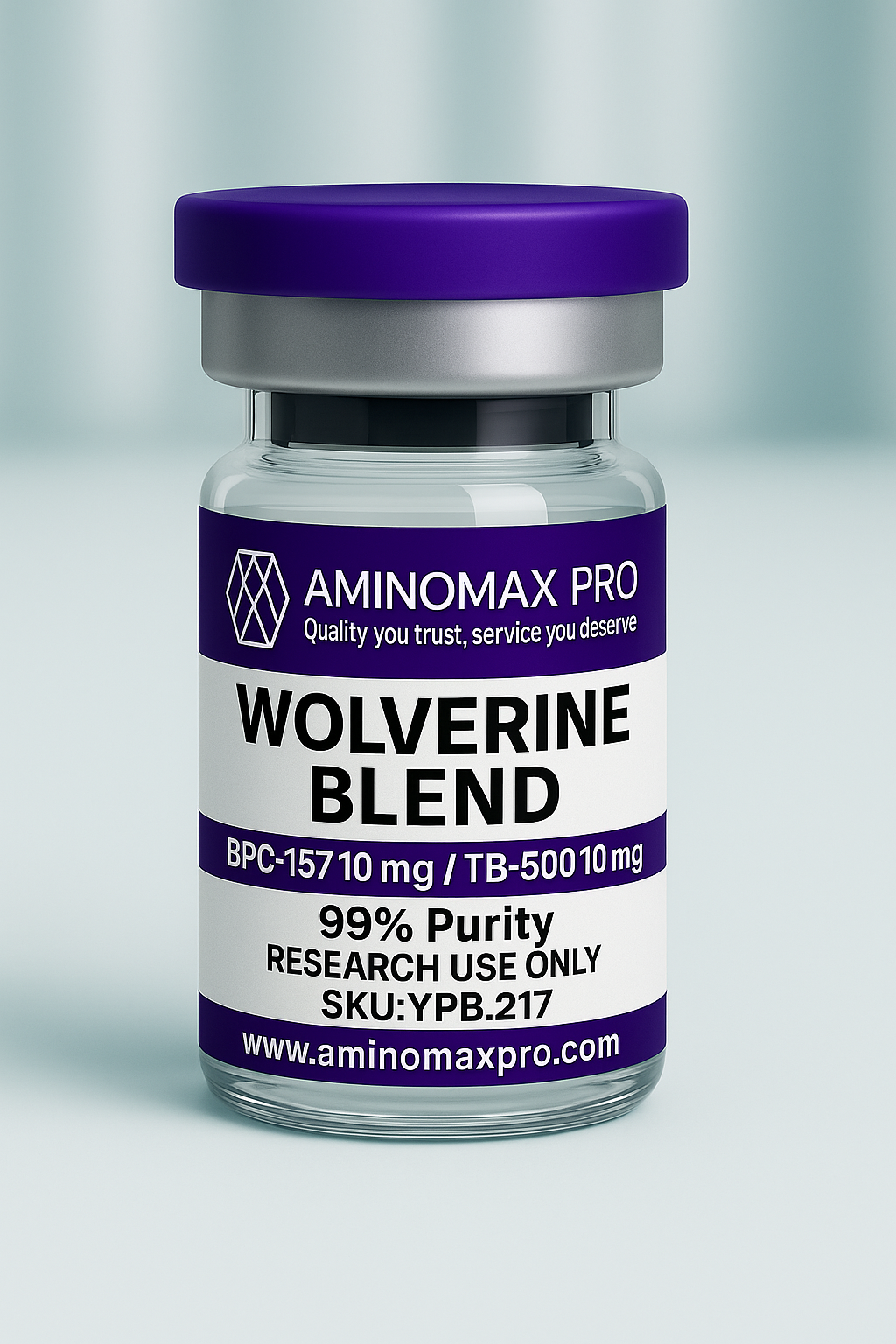

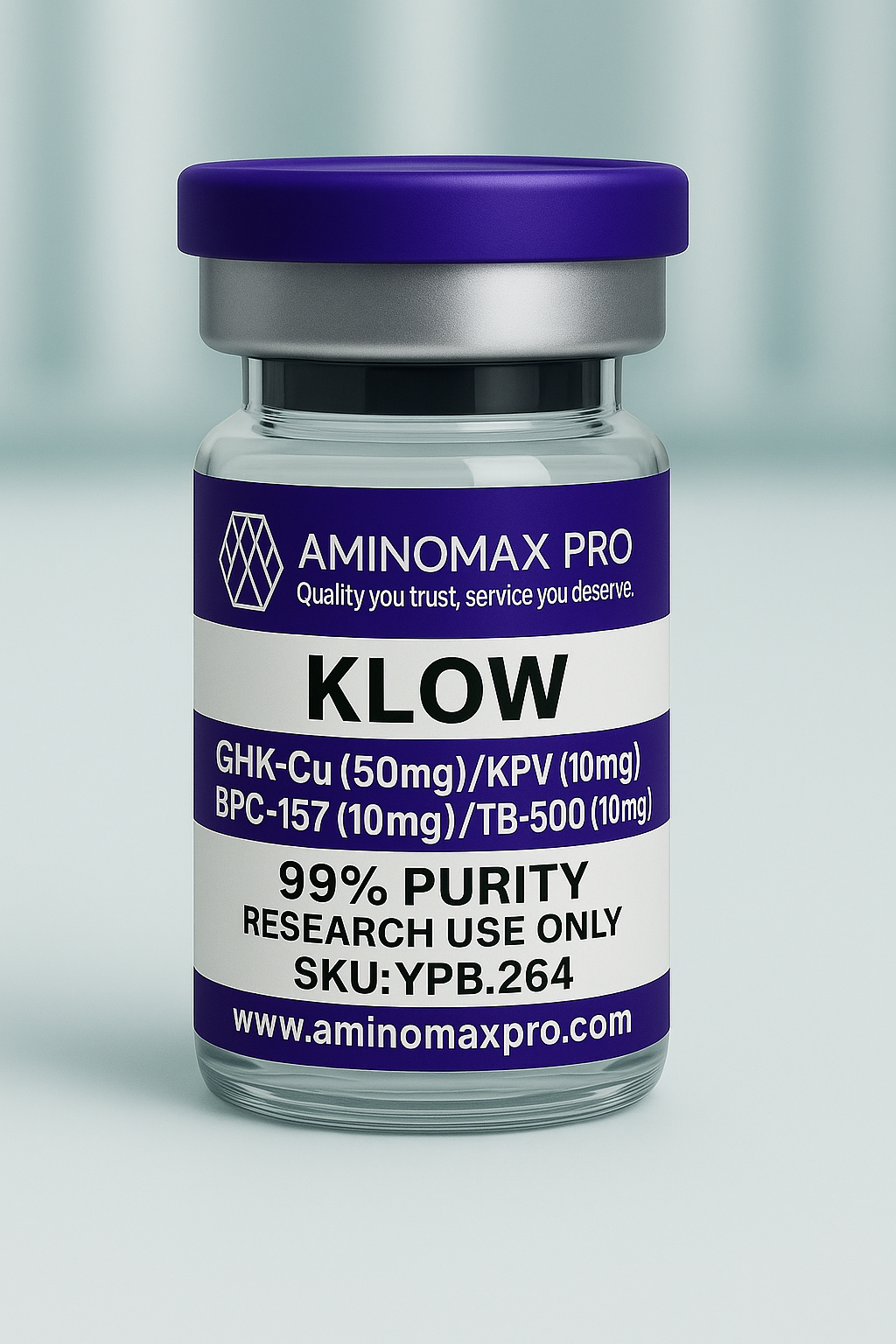
This material is supplied exclusively as a laboratory research chemical for in vitro scientific study. All descriptions and documentation are provided for informational and educational purposes only.
This compound is not approved for human or animal consumption, injection, ingestion, inhalation, topical use, or any other biological application. It must be handled only by qualified, trained personnel in a properly equipped laboratory.
This product is not a drug, supplement, food, cosmetic, or therapeutic agent, and it may not be rebranded, repackaged, or marketed as any such item. Misuse, mislabeling, or unauthorized application is strictly prohibited.
Nothing on this website constitutes medical advice, professional guidance, or a recommendation of use.
GHK-Cu + KPV + BPC-157 + TB500 (Thymosin β4 fragment)
The blend combines four peptides with complementary actions across wound biology, angiogenesis, ECM remodeling, and inflammation resolution. Mechanistically, the constituents converge on PI3K–Akt, MAPK/ERK, NF-κB modulation, TGF-β/SMAD, and VEGF/eNOS axes, with distinct primary triggers per peptide.
Primary interactions
Copper chelation & delivery: Facilitates copper-dependent enzymes (e.g., lysyl oxidase, superoxide dismutase 1) and matrix crosslinking.
Integrin/ECM signaling: Binds/heparin-affinity ECM; influences focal adhesion signaling.
Growth factor crosstalk: Upregulates VEGFA, FGF2, TGF-β in repair models.
Core pathways & enzymes
PI3K → Akt, Ras/Raf → MEK → ERK1/2
eNOS (NOS3) activation → NO output (endothelial migration)
LOX (collagen/elastin crosslinking), SOD1 (antioxidant)
Representative gene targets
ECM/Remodeling: COL1A1, COL3A1, FN1, MMP2, MMP9, TIMP1
Angiogenesis: VEGFA, KDR/VEGFR2, ANGPT1
Antioxidant: SOD1, GPX1, CAT
Integrin/focal adhesion: ITGB1, PXN (paxillin), VCL (vinculin)
Second messengers: NO, Ca²⁺, ERK1/2 phosphorylation
Primary interactions
MC1R agonism (GPCR, Gs): In keratinocytes/immune cells; increases cAMP.
NF-κB attenuation: Reduces pro-inflammatory transcription.
Core pathways & enzymes
cAMP → PKA → CREB (anti-inflammatory/repair gene programs)
NF-κB down-modulation (↓ p65 nuclear translocation)
MAPK/ERK context-dependent tuning
Representative gene targets
↓ Pro-inflammatory: TNFA, IL1B, IL6, PTGS2 (COX-2)
↑ Resolution: IL10, TGFB1
Barrier/repair: CLDN1, OCLN, KRT14
Antimicrobial peptides: DEFB4A (hBD-2)
Second messenger: cAMP↑, with downstream PKA/CREB
Primary interactions
Angiogenic axis priming: Upregulates VEGF–KDR and eNOS signaling in endothelial models.
NF-κB modulation: Dampens cytokine output under inflammatory stimuli.
Cytoskeletal/focal adhesion support: Promotes cell migration and coverage.
Core pathways & enzymes
PI3K → Akt → eNOS phosphorylation → NO
MEK/ERK (proliferation/migration)
NF-κB suppression (transcriptional)
Representative gene targets
Angiogenesis: VEGFA, KDR/VEGFR2, NOS3
ECM remodeling: MMP2, MMP9, COL1A1, FN1
Inflammation: ↓ TNFA, IL1B, IL6; ↑ IL10
Survival: BCL2, MCL1
Second messengers: NO, ERK1/2, Akt phosphorylation
Primary interactions
G-actin binding/sequestration: Regulates G-actin ↔ F-actin dynamics; enhances lamellipodia formation and motility.
Endothelial migration & tubulogenesis: Facilitates angiogenic morphogenesis.
Core pathways & enzymes
PI3K–Akt (survival/motility), Ras/Raf → ERK1/2 (immediate-early genes)
eNOS activation in endothelial contexts
Cytoskeletal regulators: Profilin (PFN1), Cofilin (CFL1), Arp2/3 complex
Representative gene targets
Cytoskeleton: ACTB, ACTG1, PFN1, CFL1, ARPC2
ECM/Remodeling: MMP2, MMP9, COL1A1, FN1
Angiogenesis: VEGFA, KDR, HIF-1A
Survival/Metabolism: BCL2, mTOR components
Second messengers: NO, ERK1/2, Ca²⁺ (motility dynamics)
| Axis | Mechanistic Convergence | Key Readouts (common) |
|---|---|---|
| Angiogenesis | VEGF–KDR → PI3K/Akt → eNOS → NO (GHK-Cu, BPC-157, TB500) | VEGFA, KDR, NOS3, HIF-1A |
| ECM Remodeling & Migration | ERK1/2, MMP2/9, integrin/focal adhesion signaling | MMP2, MMP9, COL1A1, FN1, ITGB1 |
| Inflammation Resolution | KPV (MC1R → cAMP/PKA/CREB) + BPC-157 (NF-κB↓) | ↓ TNFA/IL1B/IL6/PTGS2; ↑ IL10/TGFB1 |
| Antioxidant/Redox | Copper-dependent enzymes (GHK-Cu) + survival signaling | SOD1/2, GPX1, CAT |
| Cytoskeleton/Motility | TB500 actin dynamics; GHK-Cu focal adhesion crosstalk | ACTB, PFN1, CFL1, ARPC genes |
eNOS (NOS3) → NO (endothelial migration/vasodynamics)
PI3K, Akt, ERK1/2 → proliferation/migration/survival transcription
MMP-2 / MMP-9 → ECM remodeling
NF-κB module (p65) → cytokine transcription (KPV/BPC-157 dampening)
LOX, SOD1 (GHK-Cu–linked) → collagen crosslinking, redox balance
Actin regulators (PFN1, CFL1, Arp2/3) → TB500 cytoskeletal control
Angiogenesis: VEGFA, KDR, ANGPT1, NOS3, HIF1A
ECM/Remodeling: COL1A1, COL3A1, FN1, MMP2, MMP9, TIMP1
Inflammation: TNFA, IL1B, IL6, PTGS2, IL10, TGFB1, NFKB1
Cytoskeleton/Motility: ACTB, PFN1, CFL1, ARPC2, VCL, PXN
Redox/Survival: SOD1/2, GPX1, CAT, BCL2, MCL1
GHK-Cu: ECM/angiogenic upregulation, copper-enzyme support, PI3K/ERK, eNOS/NO
KPV: MC1R→cAMP/PKA/CREB; NF-κB attenuation; anti-inflammatory gene profile
BPC-157: PI3K/Akt→eNOS; ERK; NF-κB down-modulation; angiogenic/ECM genes
TB500: Actin dynamics; PI3K/ERK; eNOS; migration and tubulogenesis
Together, the blend targets vascular sprouting, matrix remodeling, inflammation resolution, and cell motility in vitro via coordinated cAMP/PKA, PI3K–Akt, ERK1/2, NO/eNOS, and NF-κB control.
This blend is supplied exclusively for in-vitro laboratory research.
Not approved for human or animal administration, ingestion, injection, or any therapeutic/diagnostic use.
| Weight | N/A |
|---|---|
| Size | 80 Mg |