

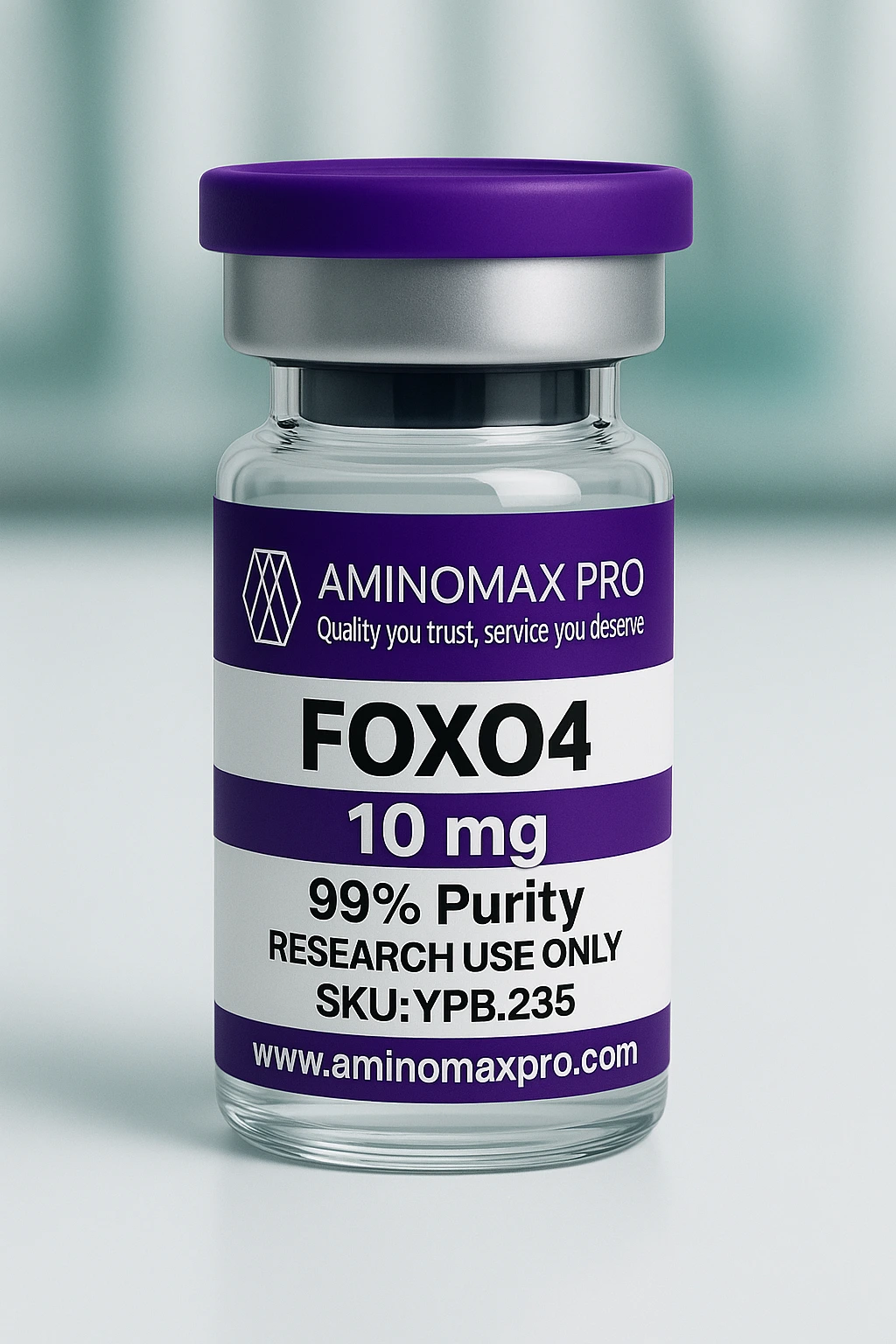
This material is supplied exclusively as a laboratory research chemical for in vitro scientific study. All descriptions and documentation are provided for informational and educational purposes only.
This compound is not approved for human or animal consumption, injection, ingestion, inhalation, topical use, or any other biological application. It must be handled only by qualified, trained personnel in a properly equipped laboratory.
This product is not a drug, supplement, food, cosmetic, or therapeutic agent, and it may not be rebranded, repackaged, or marketed as any such item. Misuse, mislabeling, or unauthorized application is strictly prohibited.
Nothing on this website constitutes medical advice, professional guidance, or a recommendation of use.
(FOXO Transcription-Factor Interference Peptide; p53 Nuclear-Retention Modulator – Research Use Only)
FOXO4-interacting peptides are synthetic sequences designed to disrupt the protein-protein interaction between FOXO4 (Forkhead box O4 transcription factor) and p53 within senescent cell nuclei.
In vitro studies demonstrate selective interference with FOXO4-p53 binding motifs, altering downstream gene-expression programs involved in survival and senescence maintenance.
| Target | Mechanistic Role |
|---|---|
| FOXO4 (Forkhead box O4) | Transcription factor controlling stress-response genes |
| p53 (TP53) | DNA-damage response and senescence regulator |
| FOXO4-p53 interface | Nuclear retention signal preventing p53-mediated apoptosis |
The peptide does not inhibit FOXO4 catalytic activity; instead, it interferes with the binding interface that keeps p53 localized in the nucleus of senescent cells.
FOXO4 normally tethers p53 to chromatin in senescent cells
Interfering peptides block the FOXO4-CR3 / p53-DBD interaction
p53 relocalizes away from nucleus in certain cellular models
| Pathway | Observed Consequence in assays |
|---|---|
| p53 signaling | Altered expression of p21 (CDKN1A), GADD45, PUMA |
| FOXO signaling | Changes in FOXO-regulated oxidative stress genes |
| AKT/FOXO axis | FOXO phosphorylation → nuclear export modulation |
| JNK/FOXO activation | Stress-response transcriptional shifts |
Although the peptide is not an enzyme, its pathway interacts with:
| Component | Role |
|---|---|
| AKT (PKB) | Phosphorylates FOXO → cytoplasmic retention |
| JNK | Phosphorylates FOXO under oxidative stress |
| SIRT1 | FOXO deacetylation and transcriptional control |
| ATM/ATR | DNA-damage signaling upstream of p53 |
| p38 MAPK | Senescence-associated transcription mediator |
These pathways regulate FOXO4 transcriptional activity and p53 stability.
| Functional Group | Representative Genes |
|---|---|
| Senescence & Cell-Cycle Arrest | CDKN1A (p21), CDKN2A (p16), GADD45, TP53, MDM2 |
| Apoptosis | BAX, PUMA (BBC3), BCL2L11 (BIM) |
| FOXO Oxidative Stress Response | SOD2, CAT, GADD45A, SESN1 |
| DNA-Damage Response | ATM, ATR, CHEK1/2 |
| SASP (senescence-associated secretory phenotype) | IL6, IL8, MMP1, MMP3, CXCL1 |
Changes in these markers are commonly measured in cell-based FOXO4 studies.
FOXO4 belongs to the Forkhead transcription factor family (FOXO1/3/4).
Contains Forkhead DNA-binding domain, CR2, and CR3 interaction domain.
FOXO4-CR3 directly binds p53-DNA binding domain to retain nuclear localization.
Interference peptides bind FOXO4 to free p53.
This leads to:
Nuclear export of p53
Alteration of survival programs in senescent cell models
Modulated SASP-linked transcription
Synthetic peptide designed to disrupt FOXO4–p53 protein interactions
Alters p53 nuclear retention in senescent cell research models
Influences FOXO/AKT, MAPK, SIRT1, and DNA-damage pathways
Affects transcription of p21, GADD45, PUMA, SOD2, IL-6, etc.
Does not act as an enzyme or receptor agonist—acts through protein-interaction interference
FOXO4-Interacting Peptide is provided exclusively for in-vitro laboratory research.
Not approved for human or veterinary use, injection, ingestion, topical use, or any biological application.
| Weight | N/A |
|---|---|
| Size | 10 Mg |



Reviews
There are no reviews yet.