

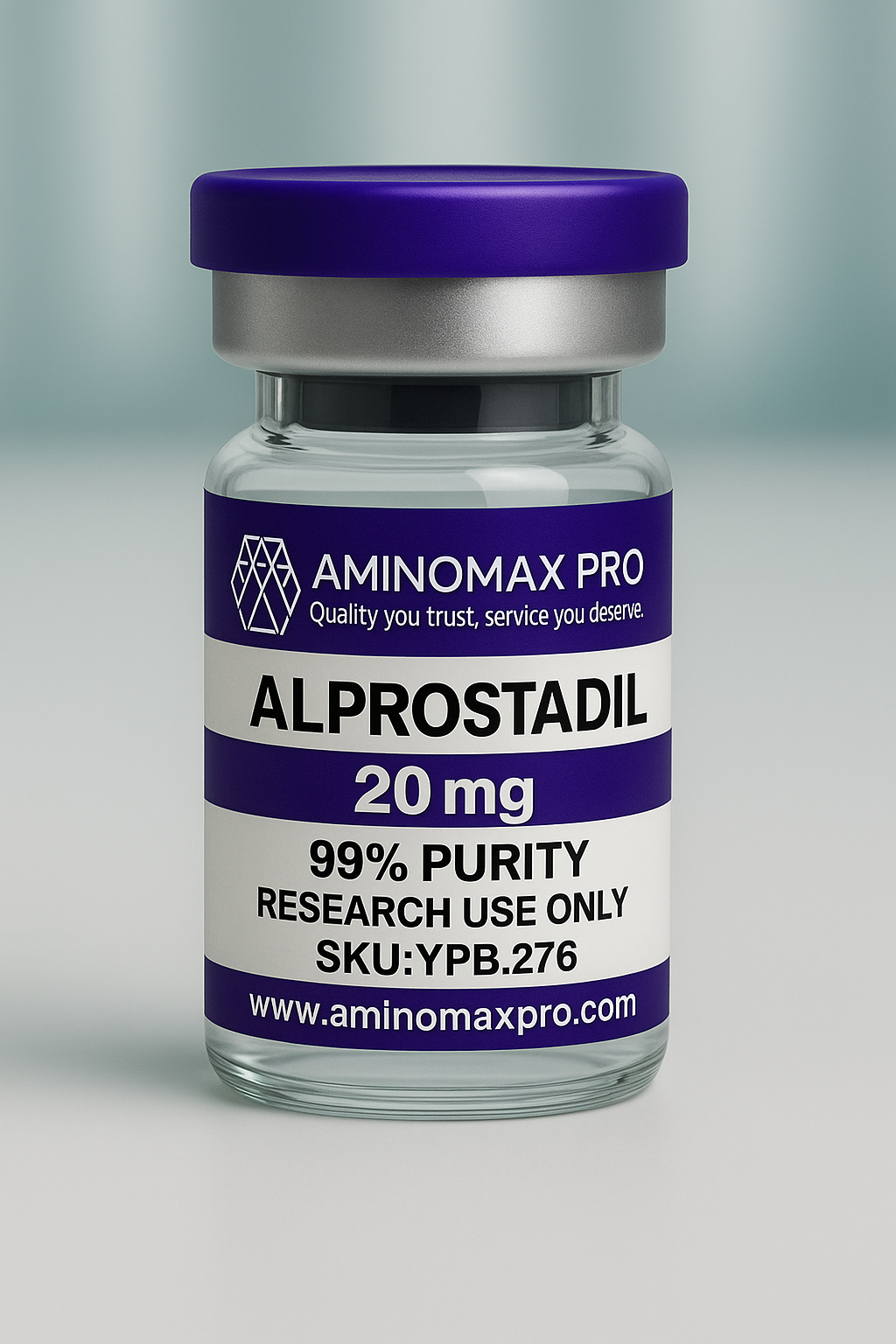
This material is supplied exclusively as a laboratory research chemical for in vitro scientific study. All descriptions and documentation are provided for informational and educational purposes only.
This compound is not approved for human or animal consumption, injection, ingestion, inhalation, topical use, or any other biological application. It must be handled only by qualified, trained personnel in a properly equipped laboratory.
This product is not a drug, supplement, food, cosmetic, or therapeutic agent, and it may not be rebranded, repackaged, or marketed as any such item. Misuse, mislabeling, or unauthorized application is strictly prohibited.
Nothing on this website constitutes medical advice, professional guidance, or a recommendation of use.
(Prostaglandin E1 / PGE₁)
Alprostadil is the synthetic form of prostaglandin E1 (PGE₁), a naturally occurring eicosanoid derived from the arachidonic acid cascade. In research models, Alprostadil functions as a G-protein–coupled receptor (GPCR) agonist, primarily activating EP2 and EP4 receptors, leading to cAMP elevation and downstream modulation of smooth-muscle tone, vascular responses, and intracellular signaling programs.
Alprostadil interacts with the four known PGE receptors—EP1, EP2, EP3, and EP4, all members of the prostanoid GPCR family.
| Receptor | Coupling | Resulting 2nd Messenger | Cellular Output |
|---|---|---|---|
| EP2 / EP4 | Gs | ↑ cAMP / PKA activation | Smooth muscle relaxation, transcriptional effects |
| EP1 | Gq | ↑ IP₃ / DAG / Ca²⁺ | Contractile effects in certain models |
| EP3 | Gi | ↓ cAMP | Counter-regulatory signaling |
In most biochemical research, EP2 and EP4 are the dominant pathways for Alprostadil’s activity, producing downstream PKA-mediated signaling alterations.
When EP2/EP4 are activated:
Adenylate Cyclase ↑
cAMP accumulation increases
PKA activation phosphorylates multiple cytoplasmic and nuclear targets
PKA phosphorylates CREB (cAMP response element–binding protein)
CREB binds DNA at CRE elements → transcriptional changes
PKA–CREB activation promotes expression of genes involved in:
Vasodilation & smooth-muscle relaxation
eNOS (endothelial nitric oxide synthase)
K⁺ channel modulation genes
Anti-inflammatory signaling
IL-10, heme oxygenase-1 (HO-1)
Suppression of NF-κB pathway components
Cyclic nucleotide metabolism
PDE-regulated cAMP/cGMP cross-talk
Alprostadil stimulation has been used to study:
Vascular tone regulation
Cellular cAMP/cGMP interplay
Endothelial transcriptional responses
Cytoskeletal and calcium-dependent contractile proteins
In cell types expressing EP1:
Gq activation stimulates phospholipase C (PLC)
IP₃ mobilizes Ca²⁺ from intracellular stores
DAG activates PKC
Studied for roles in contractile protein phosphorylation and myosin light-chain regulation
EP3 receptor research examines:
Gi coupling → inhibition of adenylate cyclase
↓ cAMP accumulation
Counterbalance of EP2/EP4 effects
Transcriptional repression through reduced CREB activation
This provides a model for studying receptor-specific bias and signaling divergence in prostanoid pathways.
In controlled in-vitro systems, Alprostadil is used to investigate:
GPCR receptor bias and second-messenger crosstalk
PKA-mediated CREB phosphorylation
eNOS gene regulation and nitric-oxide signaling
Vascular smooth-muscle relaxation pathways
PDE-dependent cyclic nucleotide turnover
Prostaglandin receptor pharmacodynamics
Alprostadil is supplied strictly for laboratory, in-vitro scientific research.
It is not approved for human or animal use, medical treatment, or diagnostic procedures.
| Weight | N/A |
|---|---|
| Size | 20 Mg |

Reviews
There are no reviews yet.