

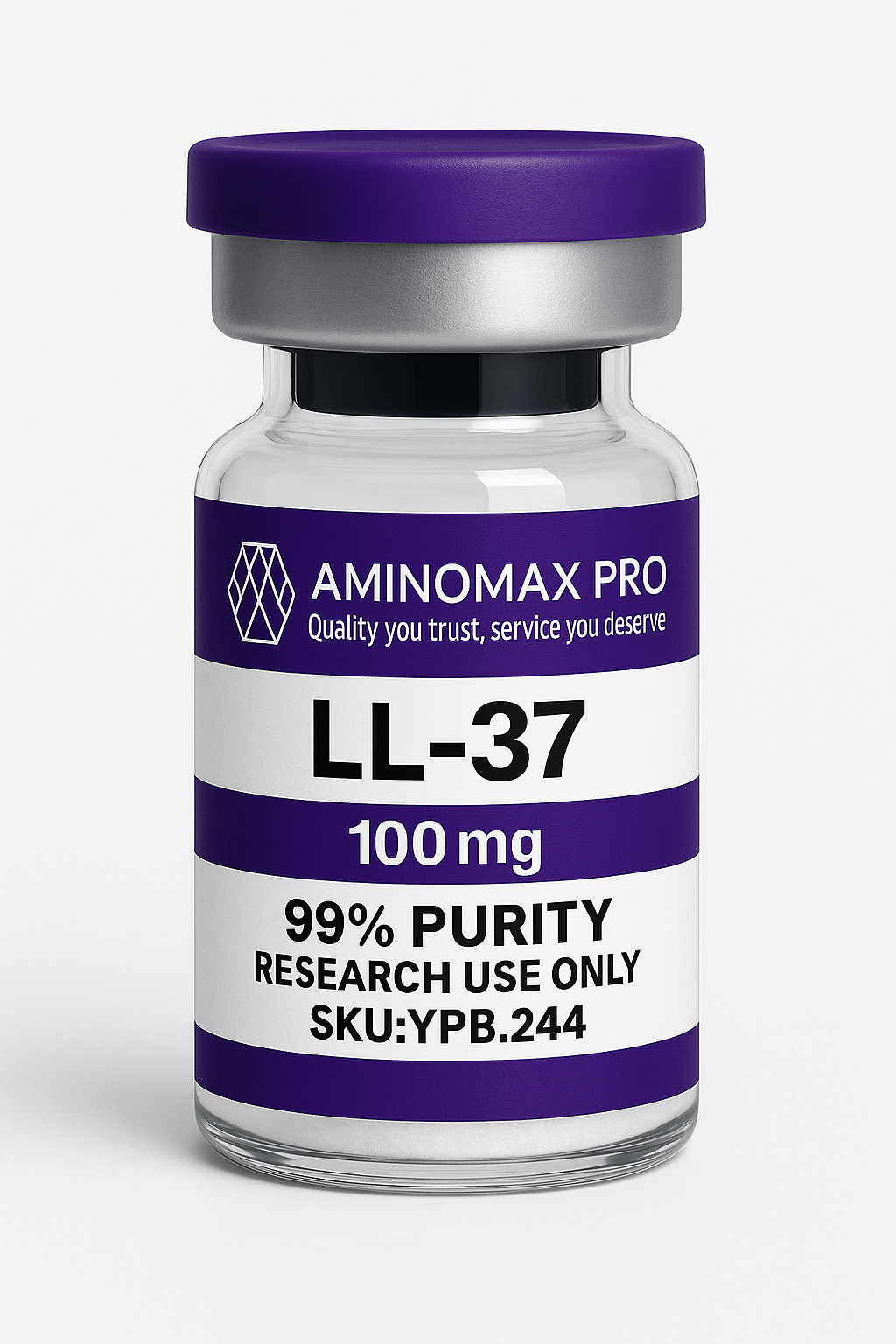
This material is supplied exclusively as a laboratory research chemical for in vitro scientific study. All descriptions and documentation are provided for informational and educational purposes only.
This compound is not approved for human or animal consumption, injection, ingestion, inhalation, topical use, or any other biological application. It must be handled only by qualified, trained personnel in a properly equipped laboratory.
This product is not a drug, supplement, food, cosmetic, or therapeutic agent, and it may not be rebranded, repackaged, or marketed as any such item. Misuse, mislabeling, or unauthorized application is strictly prohibited.
Nothing on this website constitutes medical advice, professional guidance, or a recommendation of use.
(Cationic Antimicrobial Host-Defense Peptide; Cathelicidin-Derived – Research Use Only)
LL-37 is a 37-amino-acid cationic α-helical peptide derived from the C-terminal cleavage of the human cathelicidin precursor hCAP-18.
In vitro models demonstrate that LL-37 exerts broad-spectrum antimicrobial, immunomodulatory, and wound-repair signaling functions through membrane disruption, TLR signaling modulation, and EGFR/MAPK pathway activation, resulting in differential gene transcription across immune and epithelial systems.
LL-37 interacts with:
Bacterial and viral membranes (negatively charged phospholipids → pore formation)
TLR2, TLR4, TLR9 (pattern-recognition receptors)
P2X7 purinergic receptor
EGFR (epidermal growth factor receptor)
FPR2 (formyl peptide receptor-2) on immune and epithelial cells
These interactions trigger downstream cytokine, chemokine, and repair-related signaling cascades.
Electrostatic binding to anionic phospholipids
α-helix insertion into lipid bilayers
Pore formation → membrane lysis
Loss of ionic gradient and metabolic collapse in microbes
LL-37 directly binds:
TLR2/TLR4 ligands → altered NF-κB output
CpG-DNA → TLR9 signaling
Inhibits LPS–TLR4 inflammatory amplification
NF-κB Downstream Targets Affected:
↓ TNFA, IL1B, IL6, COX-2 (PTGS2)
↑ IL10, TGFB1
Binding to P2X7 receptors promotes:
↑ Ca²⁺ influx
NLRP3 inflammasome activation in some immune cell types
IL-1β maturation and release
LL-37 triggers transactivation of EGFR, producing:
↑ ERK1/2 phosphorylation
↑ MAPK activation
↑ CREB-regulated transcription
Genes commonly monitored:
VEGFA (angiogenesis)
EGF, FGF2
MMP9, MMP2 (matrix remodeling)
COL1A1, FN1 (extracellular matrix organization)
LL-37 functions as a ligand for FPR2/ALX:
Activation of G-protein–dependent Ca²⁺ flux
Neutrophil and macrophage chemotaxis
Recruitment of immune cells to injury or infection sites in research models
| Component | Role in LL-37 Activity |
|---|---|
| NF-κB | Inflammatory gene regulation |
| MAPK/ERK | Cell migration, proliferation gene activation |
| MMP-2 / MMP-9 | ECM remodeling |
| Caspase-1 (via NLRP3) | IL-1β maturation |
| Ca²⁺ | Chemotaxis, gene transcription |
| PLC → IP₃ / DAG | GPCR signaling cascade |
| Functional Category | Representative Genes |
|---|---|
| Angiogenesis | VEGFA, FGF2, ANGPT1 |
| Inflammation Modulation | IL10, TGFB1, ↓ TNFA, IL1B |
| Matrix Remodeling | MMP2, MMP9, COL1A1, FN1 |
| Immune Recruitment | CXCL8 (IL-8), CCL2 |
| Antimicrobial Peptides | DEFB4A (hBD-2) induction |
Cationic amphipathic helix binds microbial envelopes
Inserts into membrane → torroidal pore formation
Leads to ion leakage, ATP loss, membrane rupture
Targets include:
Gram-positive & Gram-negative bacteria
Fungi
Enveloped viruses (via membrane interaction)
Endogenous human cathelicidin-derived peptide
Broad GPCR, TLR, and EGFR signaling effects
Activates MAPK/ERK, NF-κB modulation, P2X7–Ca²⁺ influx, and MMP/VEGF gene pathways
Potent membrane-disruptive antimicrobial activity in vitro
LL-37 is supplied strictly for controlled in-vitro laboratory research.
Not approved for human or animal administration, ingestion, injection, or therapeutic application.
If you’d like, I can also provide:
| Weight | N/A |
|---|---|
| Size | 5 Mg |